

Our Catholic Schools
Annunciation Parish works hand in hand with the Catholic schools in our area to support parents in their role as the primary educators of their children.
We encourage you to enroll your child(ren) in a Catholic school in west Edmonton. The schools in our area include:
- Annunciation Catholic Elementary IB World School (K-6)
9325 – 165 Street Edmonton, AB, T5R 2S5 Phone: 780-484-4319
- H.E. Beriault Catholic Junior High School (7-9)
8125 – 167 Street Edmonton, AB, T5R 2T7 Phone: 780-489-5490
- St. Benedict Catholic Elementary School (K-6)
18015 – 93 Avenue Edmonton, AB, T5T 1X5 Phone: 780-487- 2733
- St. Francis Xavier High School (10-12)
9250 – 163 Street Edmonton, AB, T5P 0A7 Phone: 780-489-2571
- St. Thomas More Catholic Junior High School (7-9)
9610 – 165 Street Edmonton, AB, T5P 3S6 Phone: 780-484-2434
- Bishop David Motiuk Catholic Elementary/Junior High School (K-9)
855 Lewis Greens Drive, Edmonton, AB, T5T 4B2 Phone: 780-409-2603
- St. Josephine Bakhita Catholic Elementary/Junior High School (K-9)
145 Secord Drive NW, Edmonton, AB, T5T 7N8 Phone: 780-670-2946
- Our Lady of Victories Catholic Elementary School (K-6)
7925 158 St NW, Edmonton, AB T5R 2B9 Phone: (780) 489-7630
For Teachers
The Catholic Archdiocese of Edmonton offers the following guidelines and resources
Standards for Preparing children and Youth for the Sacraments
– Includes Best Practices for Home, Parish and Catholic School, Order the Sacraments, Reverence in Church
Additional Resources:
Sacramental Standards additional resources
– The purpose and role of Sacramentals
The purpose of the sacraments is to make people holy, to build up the body of Christ, and finally, to give worship to God; but being signs, they also have a teaching function. They not only presuppose faith, but by words and object, they also nourish, strengthen, and express it; that is why they are called “sacraments of faith.”
The sacraments impart grace, but, in addition, the very act of celebrating them disposes the faithful most effectively to receive this grace in a fruitful manner, to worship God rightly, and to practice charity.
rcsj.org/sacraments
Understanding the Role of Sacramentals in Our Faith
Parish History
In May 1956, two priests from the Oblates of Mary Immaculate (OMI), St. Peter’s Province, Ottawa, came to Edmonton at the request of the Edmonton Separate School Board to teach at St. Joseph’s High School. The following June, the Jasper Place Separate School Board asked if one of the priests could take the post of Principal of St. Luke’s High School. Thus Father Brendan Megannety, OMI, and Joseph McNeil, OMI, came to live at a small house at 9601 – 163 Street. With the completion of the new St. Francis Xavier High School in 1959, these two priests were joined by Father John Mulligan, OMI. Masses were held in the school auditorium.
The first parish priest, Father Myles Power, OMI, arrived in August 1959, and during his two years in Jasper Place, he organized what was then called St. Francis Xavier Parish, and began plans to build a church. Father James Carroll, OMI, continued this work and construction began in early 1962 with architect George Jellinek. Construction was of reinforced concrete and steel over an area of 12,900 square feet for a seating capacity of 730.
An outstanding design feature was the long, high nave, achieved by the use (at that time) of the longest unsupported steel trusses in Western Canada, giving an unobstructed view of the altar from every part of the nave. Fifty-four lamps scattered in random pattern high up gave a starlight effect, and behind the black marble altar rose a mural symbolizing the sacraments, designed by Herta Jellinek, wife of the architect. Suspended from the 22 foot cross placed in the Sanctuary was a seven and a half foot lindenwood figure of Christ, carved in Bolzano, Italy, by Ferdinando Stuflesser Studios.
The Stations of the Cross were unique in Canada, being a revival of the medieval technique of painting in reverse on glass. The 14 tableaux, a gift from the architect, were the work of Ms. Ernestine Tahedl, a young Viennese artist who had recently arrived in Canada.
The church and the rectory were completed in June 1963 at a total cost of $319,571 for construction and furnishings. Solemn blessing, dedication and opening ceremonies were conducted by His Grace Archbishop Anthony Jordan, OMI, on May 19, 1963.
As his last official act in 1961, Father Myles Power requested of His Grace Archbishop Jordan that the title of the parish be one of Our Lady’s titles. The name “Annunciation” was chosen, made official, and used for the first time May 12, 1963.


What are Holy Orders?
Discerning the Call to Serve in the Permanent Diaconate
What is your Vocation?
Do you feel called to religious life?
– Orders of Women Religious
– Orders of Men Religious
Be Not Afraid Video Series
Deacon Karl Pierzchajlo
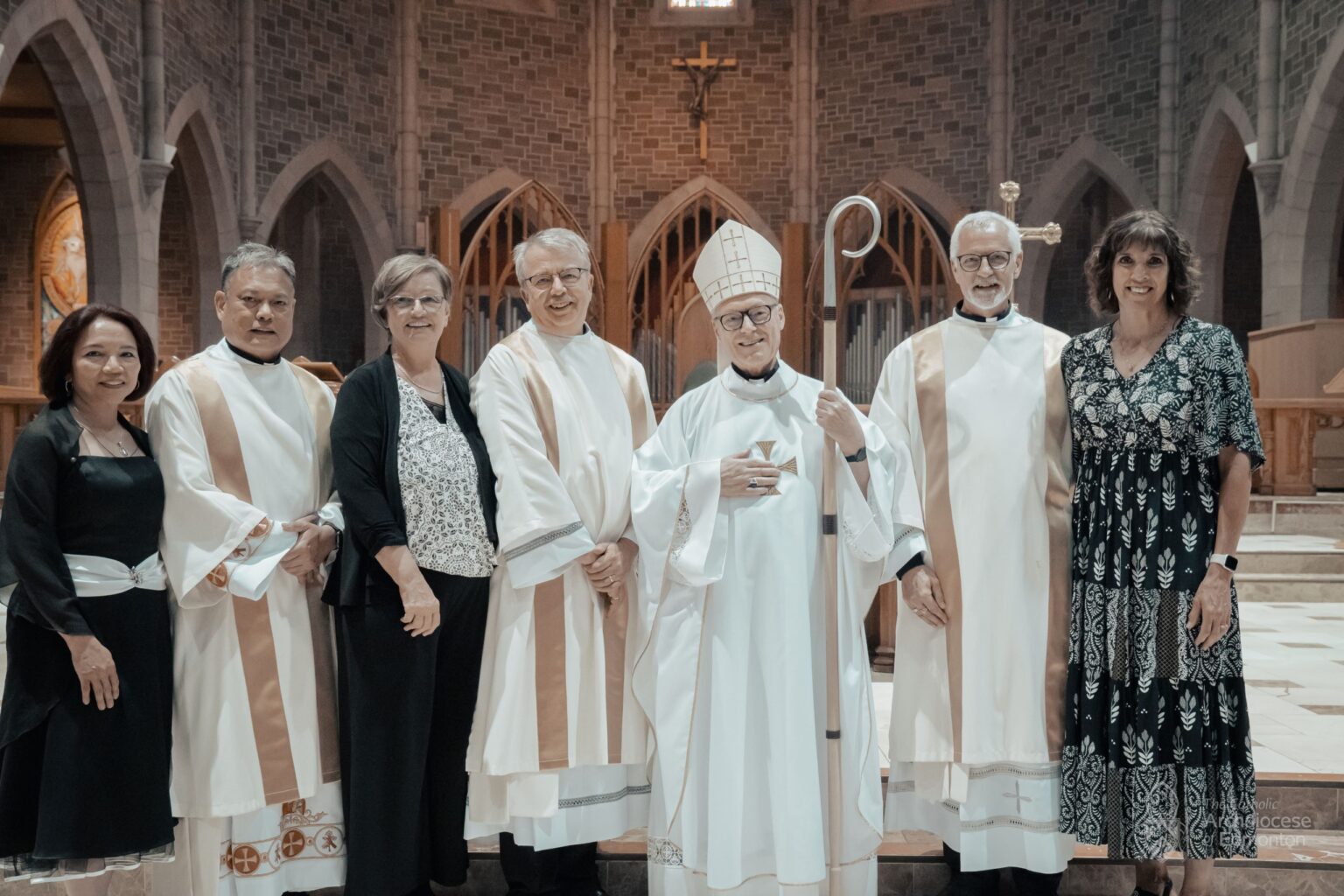
Deacon Karl Pierzchajlo, a member of the clergy at Annunciation Parish, was one of three new permanent deacons ordained to the ministry of the Permanent Diaconate in the Archdiocese of Edmonton at St. Joseph’s Basilica on July 22, 2025. Bishop Paul Terrio, retired bishop of St. Paul, served as the principal celebrant.
Learn more about Deacon Karl and his ministry from the Catholic Archdiocese of Edmonton articles below:
Watch the Mass of Ordination to the Permanent Diaconate streamed live on Jul 22, 2025 at St. Joseph’s Basilica (right)
What is the Permanent Diaconate?
Receiving the Sacrament of Holy Orders, a deacon is an ordained minister in the Church called to model Christ’s humble service — both within the parish and in the world. A permanent deacon’s ministry evolves in response to the needs of the Church and his unique gifts, modeled after the threefold apostolic ministry of the Bishop: the ministries of charity (love and justice), the Word of God, and sacrament.
Permanent deacons assist in preparing the faithful to celebrate the sacraments and live out their baptismal vocations. They are entrusted to preach, teach, counsel, and offer spiritual guidance to God’s people.
Deacons may also baptize, witness marriages, and preside at wake services and funerals (without Mass). In all that they do, permanent deacons act as true servants of Christ, bringing His presence to the margins of society.